Author Archives: Joan Treppa

Unintentional Losses…

How many times have we seen car ads that boast about this feature…?  From zero to 60 mph in a matter of seconds!

This type of maneuvering has been proudly embraced by car manufacturers for years as a top selling point over other makes and models. But truth be told, no other car manufacturer has anything that surpasses the capabilities of a Toyota Camry! Certain model year Camrys can go from zero to ninety in as much time and they have a track record to prove it.

I’m just speculating but based on this news report from a recent class action lawsuit in a Minneapolis courtroom which garnered much attention nationwide, exoneree, Koua Fong Lee, former owner of a 1996 Toyota Camry along with the family of the deceased victims of an Oldsmobile Ciera, would probably agree that this is not a factor to be celebrated. In fact, they have asked Toyota, Corporation to fix a serious problem of unintentional acceleration due to issues with the car’s electronic throttle mechanism so that it does not cause devastating harm to more lives.

“Lee was driving his pregnant wife, their 4-year-old daughter, and his father and brother home on June 10, 2006, when he exited Interstate 94. As his Camry accelerated, he sideswiped one car before hitting an Oldsmobile Ciera. Experts said Lee’s car was traveling between 76 and 91 miles per hour when it struck the Ciera, killing its driver, Javis Trice-Adams, 33, and his 9-year-old son, Javis Adams Jr. Trice-Adams’ niece Devyn Bolton, 7, was paralyzed and died 16 months later. The three who died were “complete innocents,” said attorney Bill Markovits, who is representing the Trice-Adams family. “We ask you to hold Toyota fully liable,” he said.”  Star Tribune, Jan. 8, 2015

Despite numerous other drivers of the same make of Camry who have come forward because of experiencing sudden unintentional acceleration; the same issue that Lee insists caused his crash, Toyota stands by its assertion that the fatal crash in 2008 killing three people and sending Lee to prison for 2.5 years was solely due to driver error. Part of their argument during the recent hearing states Lee was an inexperienced driver and that he had mistaken the gas pedal for the brake pedal. They also argued that his 1996 model was not involved in a future recall event that dealt with the very problem he experienced.
ows_142077539691923

Lee’s 1996 Toyota Camry. (Photo courtesy of Star Tribune, Mpls, MN) 

“Lee was convicted of criminal vehicular homicide and sentenced to eight years in prison in 2007. A massive recall of newer Toyota models because of problems with sudden acceleration, starting in the fall of 2009, prompted attorneys to reopen Lee’s case. Ramsey County prosecutors dismissed the charges against him in 2010. The 1996 Camry was not among the vehicles recalled. Lee and four family members who were passengers in the Camry joined with family members from the Oldsmobile in a suit against Toyota.”Star Tribune, Feb. 4, 2015

ows_142302270498185

Koua Fong Lee at a press conference in Mpls following a jury verdict. (Photo courtesy of the Star Tribune, Mpls, MN) 

“Trembling as he spoke, and occasionally lifting a tissue to his face, Lee said, “I tried to rebuild my life, but it is very difficult to move on. I am very sad. I want to apologize to the other families” who had members killed or injured. “Every day I think about that accident,” he said, appearing to be on the verge of tears. “Many lives lost.” –Star Tribune, Jan. 10, 2015.

“Toyota’s attorneys appeared to be caught off guard. Driver Koua Fong Lee lost control of his 1996 Camry, said his attorney Bob Hilliard, because each time he tapped the gas pedal on the long exit ramp off eastbound Interstate 94 at Snelling Avenue, the car accelerated.” –Star Tribune, Jan. 29, 2015

This week’s outcome:

“Toyota Motor Corp. must pay $10.9 million in damages for the high-speed crash in St. Paul that cost the lives of three people and sent another man to prison, a federal jury decided Tuesday. Jurors in the Toyota liability trial found the world’s largest auto company 60 percent responsible for a 2006 crash that also sent a St. Paul man to prison for 2½ years. They found Koua Fong Lee, driver of the 1996 Toyota Camry that crashed into a stopped car at the top of an Interstate 94 exit, 40 percent responsible.” –Star Tribune, Feb. 4, 2015

My thoughts drift between deep empathy for both families involved in this terrible incident and what the answer is, as to the appropriate responsibility and duty of the nation’s largest automobile company. Personally, I had hoped that Toyota would have seen a clear and evident problem with their product, and that precious lives are still being destroyed because of it. It would have been prudent for them to take a more compassionate approach. They should have shown the world that their company is based on the highest standard of integrity, by putting their funds towards more in-depth research and to get to the bottom of this issue rather than paying multiple attorneys to blame the victims.

Honestly, I believe what will end up happening is that enough people will feel the same way as I and will seriously consider their next car purchase with this lawsuit in mind. Of course, there will be those who stand by Toyota no matter what because they like the product, but I think that in the long run, Toyota may have already caused their own demise which will likely affect their bottom line as well as their reliability, not to mention their unintentional loss of integrity.

Vroom  Vrooooooooooooooooooooooooooooom…………                                                                                                                 

images   

Was it Murder…Pt 2

This segment examines the ineptitude and legal challenges of the defense attorneys in a joint trial setting.

Ineffective Assistance of counsel…

“The expert report of pre-eminent Wisconsin criminal lawyer, Stephen Glynn, Esq., explains why Kutska’s defense counsel failed to provide the diligent, thorough, and skillful representation that was required in this case and how that failure prejudiced Kutska’s defense and claim of innocence. In particular:

  1. Kutska’s defense counsel was obligated to (a) consult with and retain an independent forensic pathologist to challenge and disprove, if possible, Dr. Young’s homicide testimony and also to (b) investigate the strong possibility that Monfils had committed suicide. The need to investigate the question of suicide was apparent in light of Monfils’ mental and emotional history, the stresses in his life, his experiences in the Coast Guard, his pre-occupation with death and drowning, and his failed marriage. Instead, defense counsel made the uninformed and catastrophically prejudiced concession of an element of the charge–that Monfils had been beaten and murdered as Dr. Young and the prosecution contended. As Mr. Glynn states, those concessions and failures lacked any strategic justification.
  2. Had defense counsel investigated the medical examiner’s findings and conclusions and whether Monfils had taken his own life, they would have shown the jury why the prosecutor’s homicide theory was not merely doubtful, but flatly wrong, thereby undermining the credibility of certain key witnesses. Defense counsel’s concessions and failures led the jury to assume instead that the prosecution’s case was based on solidly reliable scientific, medical and other evidence, including the false testimony of the prosecution’s two most critical fact witnesses—Brian Kellner and David Weiner.
  3. Defense counsel had ample means, including through the use of formal discovery in the companion civil wrongful death litigation, to obtain the evidence with which to develop a powerful suicide defense. Indeed, suicide was then, and still remains, the only theory that is fully consistent with both the evidence that existed and the evidence that did not exist.
  4. Defense counsel’s concessions and failures limited Kutska’s defense to the sole contention that someone else had beaten Monfils and disposed of his body in the vat. The overriding problem with that defense, however, was that Kutska’s counsel lacked sufficient evidence pointing to anyone who might have done so in the closed environment of the mill. Moreover, Kutska was the person in the mill that day with a proven reason to be upset with Monfils and who had been with and near Monfils in the minutes leading up to Monfils’ disappearance. Kutska was, therefore, the prime focus of the homicide investigation. Defense counsel for the other defendants likewise could not point a convincing finger at anyone (other than one or more of the co-defendants, including Kutska). As counsel for one co-defendant candidly admitted in his closing argument, “[w]e have no theories about this case.” Similarly, in post-conviction proceedings, Kutska’s counsel never (a) attacked Dr. Young’s homicide testimony or the prosecution’s contention that Monfils had been beaten and then deposited into the vat where he died and never (b) investigated or presented the evidence pointing toward Monfils’ suicide.
  5. Kutska’s counsel was further deficient at trial and in post-conviction by failing to show that (1) Sgt. Randy Winkler’s coercive tactics had corrupted the investigation and the trial with perjured statements and testimony from certain key witnesses; (2) Winkler perjured himself and engaged in other acts of dishonesty; (3) other key prosecution witnesses, including David Weiner, James Gilliam, and James Charleston, also perjured themselves; (4) Weiner had an arrangement or understanding with the prosecution for his testimony that both he and the prosecution denied; and (5) the prosecution’s arguments were illogical, conflicting and made up.

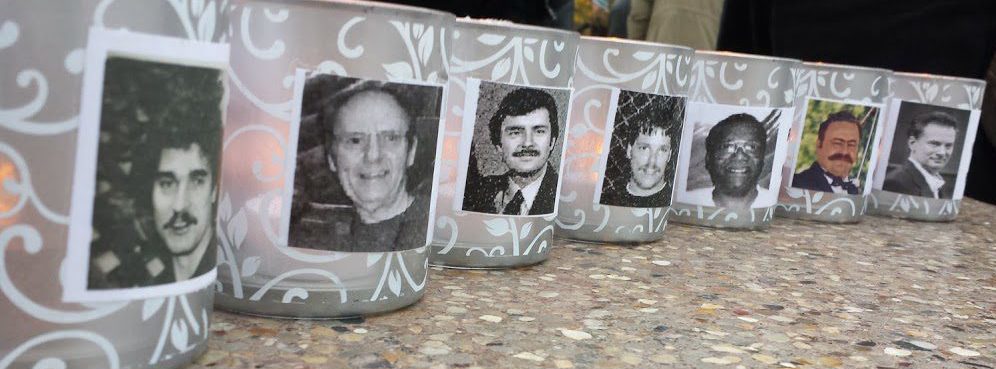
Corroborated Facts:  On November 21, 1992, the body of Tom Monfils was found. Approximately two and a half years later, on April 12, 1995, six men were arrested for his alleged murder and on September 26, 1995, a joint trial involving these six men began. Then on October 28, 1995, all six of these men were found guilty of murder.

P1040654

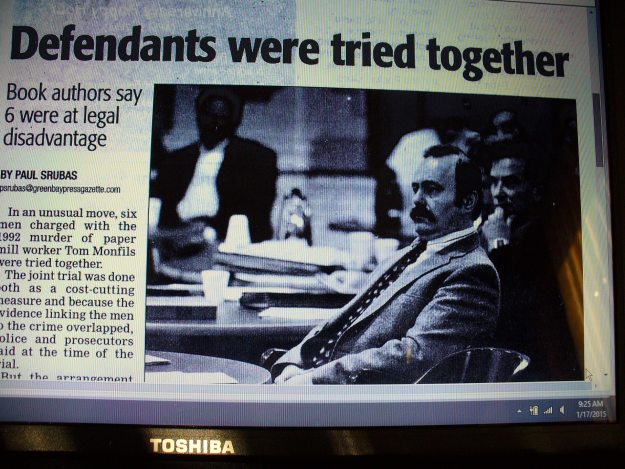
Keith Kutska listens during the Monfils trial in 1995. (Photo courtesy of the Green Bay Press-Gazette)   

The trial was conducted as a joint effort with all co-defendants lined up in a row next to their attorneys. The book suggests with separate trials the six men would not have been convicted of murdering Monfils because trying all of the men together automatically destroyed each man’s ability to create an independent defense. The idea that this joint strategy might confuse the jury was an unavoidable consequence. Despite the judge’s directive to the jury that not all testimony pertained to all of the defendants, evidence against one of the men was automatically applied to all of them. This idea was unmistakably evident in a letter from a juror to Mike Piaskowski years after he was exonerated. “It was too much to process and too easy just to make the same judgment for all of the defendants.”  Coupled with the complexity of information laid out during the twenty-eight-day trial, three of the six men were named Michael.

The defense attorneys recognized the unfair burden of a joint trial and they filed several pretrial motions demanding separate trials. Tax-dollar savings and consideration of the emotional state of the victim’s family won, compelling the trial judge to deny each of these motions.

There was an order in which each attorney was allowed to question each of the eighty-one witnesses. This system could not be altered during the entire trial. Attorney number one was always given the first opportunity to ask his question. If attorney number five, for instance, was not satisfied with the answer and raised it again when his turn came up, the judge would dismiss it as “asked and answered” and the attorney was told to move on to his next question.

Unfortunately, all of the defense attorneys agreed at the onset of this joint trial to disregard the suicide theory…period! All else aside, this was the most crucial mistake they could have made because, in fact, it was their only defense. That mistake cemented the convictions of all six of these men.

Nurturing a Legacy…

“I’ve learned that people will forget what you said, people will forget what you did, but people will never forget how you made them feel.” ― Maya Angelou

Inspirational quotes often get acknowledged, passed around but then soon forgotten, as though their purpose is for someone else to fulfill. I saw this one and felt compelled to share its wisdom as a remembrance of the amazing Maya Angelou who passed away in 2014. It represents much of how I view myself.

It’s a new year and my commitment to help five wrongfully convicted men is entering its sixth year. From the start of this journey, I’ve had supporters enthusiastically board the freedom train. Some who’ve ridden with me from the start are still with me while others have exited. Supporters come and go and I’m okay with that because this expedition is long and fraught with laborious uphill battles. I appreciate that we all have our limits and that it’s easy to grow weary. All any of us can do is try our best which to me is priceless. My spirits remain high in this calling I was chosen for. I know my commitment will never falter. Knowing that my whole life has prepared me for the challenges I face now keeps me steady and on course.

I think of how my spirit was silenced for most of my younger years. I remember feeling different, even ashamed of who I was. I never thought of myself as a leader. Life was about keeping a low profile and walking in the shadows of everyone else. I was desperate to fit in, to be liked, to have nice clothes. But that never happens to poor kids. Poor kids are stupid, frowned upon, funny looking, and different. Not worth the attention…at least, not nice attention. Because of those stereotypes, being different was not an attribute to be proud of.

It was a new experience and a blessing to finally realize my potential and to understand what I was meant to accomplish, and to not be ashamed of the hardships that got me to this place and time. When I was introduced to the plight of the wrongfully convicted I realized that my life would be incomplete until I opened my heart to receive the gift of leadership. That was when it really became clear that being different was essential and that the characteristics I possessed were exactly what were needed to pursue this legacy. I am still seen by others as different but what is great about that is my own understanding about being different. It takes courage to stand out. It takes abilities and strengths that many don’t have. What I feel now is a strong sense of self pride because I understand my life has valuable and that it can benefit others if I nurture my strengths in the proper way.

Our everyday actions become a culmination of our ethics…our biases which are cultivated through past experiences, observations and lessons learned. We generally call this influence. I prefer to define it as inspiration. Inspiration to me suggests provocation which leads to action. And I am certainly all about that. An example of this is when that lone red fox saunters through our backyard in broad daylight without a care in the world. He/she most definitely inspires the squirrels and rabbits to hightail it out of there with the utmost expediency! In that respect, inspiration motivates amid the presence of chaos. This is an awesome revelation for me. It is one thing to be influential but we often forget about our capacity to inspire. It’s empowering to realize we constantly initiate and react to inspiration on a daily basis. How we develop over time heavily depends on interpreting the tiniest indicators of inspiration such as that subtle squeeze of reassurance in a handshake, the emphasis on a specific word in a sentence, or a subtle facial expression that speaks more effectively than the spoken word.

Most of us don’t appreciate the multi-directional highway on which inspiration travels in everyday life. It comes in many guises both positive and negative. If we are indecisive and ignorant to its true meaning, we risk sabotaging the benefits, and miscalculating who we are meant to become. Keep in mind that we all travel on that same highway but what differentiates our paths is our ability to effectively sort out and process all of those tiny subtleties, categorize them into some sort of manageable semblance and to accurately define who we are based on the importance we’ve placed upon each one. This is not an easy task. But it is a vital one if we are to succeed in leaving this place better than when we arrived, or encouraging any kind of a worthy legacy.

Each morning as I catch up on the latest news and learn about all of the tragic events that have and are occurring all around the globe, I welcome the solace of knowing I try to be as akin in my movements as that lone fox. My step is one of purpose and determination, done with an intent to rouse, to initiate change, to abolish ignorance, and to lead with good intentions rather than with empty words. I know I am on the right path to gaining further knowledge and strength regarding my own potential. It is my wish that everyone experience the same in their lives because I’ve seen all too often, the anger associated with an unaccomplished and unfulfilled life.

There is so much I want to accomplish as I enter into this new year. I am hopeful that time will permit me to do at least most of it. Come along if you wish-stay however long you can. But know that I will not judge as I sit on that train for the duration of this ride!

This past year marked real progress in my mission to help free these men when the very competent and highly respected Minneapolis law firm of Fredrikson & Byron filed a motion on October 31st on behalf of Keith Kutska; the lead suspect in the case. This means that it could be heading back to court. Hmmm…not a bad legacy for an unknown suburban wife and mother from Blaine, Minnesota.

In the next few weeks I will elaborate on aspects of that motion.

May you all have a wonderful New Year…