Meeting someone who’s been in prison for a crime they did not commit is very humbling. But observing within them, an attitude more positive than many of us not affected by our judicial system, is surprising…and noteworthy. Mario Victoria Vasquez is such a person. He is conscientious, thoughtful, kind, patient and grateful for his new found freedom and for the outpouring of support he has received through his terrifying ordeal. Mario is also proud. He harbors anger because of what happened to him but he does not let it dominate his overall temperament despite these past circumstances…
“On February 5, 1998, the parents of a four-year-old girl took her to the St. Vincent’s Hospital in Green bay, WI because she had been complaining for two days of pain while urinating. The girl told a nurse that “Mario” had touched her. Based on a physical examination which revealed sores and vaginal irritation, hospital staff determined the girl had been sexually assaulted. A swab was taken and tested positive for genital herpes. The girl’s mother believed she was referring to 34-year-old Mario Victoria Vasquez, the babysitter’s brother-in-law who lived at the babysitter’s house. However, the uncle had disclosed to authorities that the girl sometimes referred to him (the uncle) as “Mario”. A Green Bay Police Detective questioned the girl alone. According to him, she volunteered that she had been touched by her uncle, father and babysitter’s husband as well, but on February 6, 1998, Vasquez was the one arrested and charged with first-degree sexual assault of a minor. Tests were never performed to determine where the disease originated from and the defense counsel was negligent in requesting that an expert be called in to debate; (a) the validity of the testimony of a four-year-old; (b) her obvious confusion of the facts throughout the process, (c) evidence of interviewer bias.
Mario had served close to seventeen years of his twenty-year sentence, all the while, maintaining his innocence. He was unexpectedly released from prison on the evening of Friday, January 30, 2015 after a hearing earlier that day to request a new trial. The assault victim, now an adult, had finally come forward to disclose who her true assailants were.
Although this was reason enough for Mario to celebrate, the circumstances surrounding his actual release were not. Mario walked out of the Brown County jail in the middle of a chilly wintry night…alone. He was equipped with inadequate clothing–a light jacket, no hat or gloves, and no means to contact a family member to pick him up. He was forced to go back into the jail to ask if he could use their phone. It was sheer luck that he remembered his son James’ phone number.

Exoneree Mario Victoria Vasquez and Joan Treppa
Up until the present, I had only known Mario through letters. We had corresponded since August of 2013 because of a conversation I had with his ex-wife, Darcy. Both Darcy and my sister, Clare, are friends who live in Green Bay. Darcy became upset one day while the three of us chatted at my sister’s house after I brought up my recent involvement in the Monfils case. “I cannot be concerned over that case when no one cares that my ex-husband, Mario, also sits in prison for a crime he did not commit.” she said. “Tell me about him,” I said. Our conversation prompted me to start writing to Mario.
I told my sidekick, Johnny, about this case. He did an investigative evaluation of the facts. He then confirmed that Mario’s case was fraught with the same kinds of issues and inconsistencies as in the Monfils case. He found out that the same prosecutor and assistant DA worked on both cases within a few years of each other; a connection that sent up huge red flags. Mario was already under the guise of the Wisconsin Innocence Project (WIP) by then, though he felt discouraged because of how long it was taking to get his case through the courts. I encouraged him to give them time and assured him that they were doing their very best for him.
The essence of Mario’s letters embodied the utmost respect for others. He struck me as an educated and well-versed individual. I sensed he was hard working and motivated to continue on with a productive and meaningful life. He maintained integrity despite his tragic misfortune. His letters were similar to reading poetry. In them, he shared acts of kindness toward other prisoners through mentoring and friendship. The more I learned, the more I wanted to meet him.
On the evening of Tuesday, February 10, 2015, I came face to face with my pen pal. For a moment, Mario and I stood there, staring at each other as though this was a dream. We marveled at the ability to share a handshake, a joke, laughter, tears and a hug. Still, Mario’s fate hung in the balance. A hearing was to be held the following day to determine whether or not this nightmare would be over. Although I was optimistic, Mario would not be at peace until he received word from the Judge that he was absolved of all charges. There was an edginess in his temperament and I did my best to grasp what he was feeling. I reassured him that no matter what, I would stand by him.
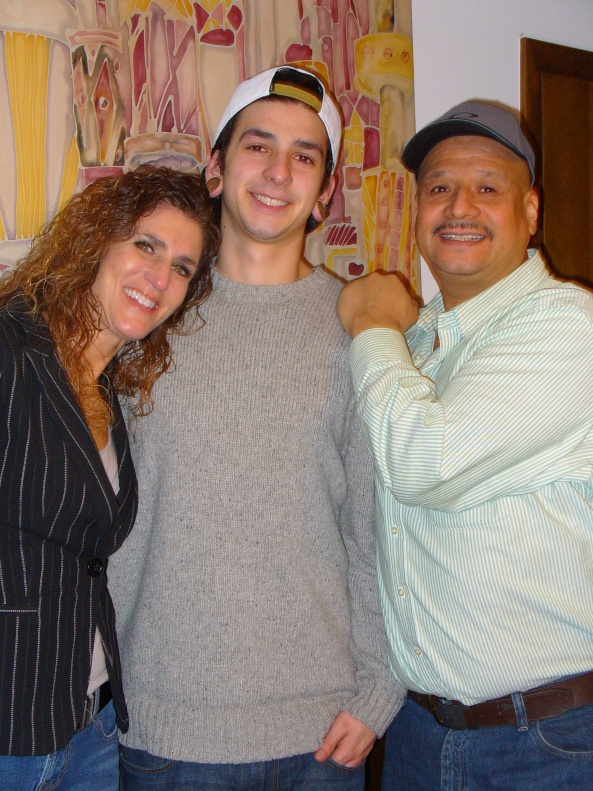
A Family Reunited; Darcy, James and Mario
My sister, Clare, hosted this informal gathering of close friends and family on Tuesday evening. Darcy, their son James, and James’ girlfriend, Sarah, were present. It was the first time this family had been together since Mario was charged in 1998. We all savored the moment…that evening…this miracle.

Exonerees Mario and Mike “Pie”
Also invited to this special gathering was Michael “Pie” Piaskowski, the exoneree from the Monfils case, along with his girlfriend, Teresa. Mike Pie and Mario became fast friends. They sat together, sharing individual stories with eerie similarities. Many emotions were felt that evening; anger, sadness, and disgust for a system gone awry. But we focused on new possibilities and a brighter future for Mario, Mike Pie, and for the many innocent people in prison who have yet to be vindicated.

Mario (center) with WIP Attorneys; Cristina, Catie, Kyle and Curtis
The next day, the hearing for Mario commenced at 1:30 pm in room 200 of the Brown County Courthouse. Cristina Borde, Mario’s lead attorney from the WIP, had mentioned the proceedings would be brief so we arrived early. Mike Pie, Clare, Darcy, and I waited in the hallway with approximately twenty-five of Mario’s family members. Excitement grew when the innocence project team walked in. Their presence lent a sense of comfort and excitement similar to the climax of a tense western film when the cavalry arrives on the scene to save the day! Mario was ecstatic to see all of us. This was his moment. We were his bravado!
We all entered the small courtroom. We sat and waited. In walked the former Brown County Assistant District Attorney, Larry Lasee, with a sour look on his face. He kept his gaze lowered as he sat in his designated chair. He began scribbling furiously on the notepad in front of him. We rose and settled in again after Judge Hammer entered. Cristina rose and began by defending Mario’s innocence. Mr. Lasee clarified his view in regard to Mario’s absolute guilt. He then added that the DA’s office would not be pursuing a new trial in this matter. The Judge displayed a puzzled look and defined the series of events prompting this hearing; that Mr. Lasee had, in fact, interviewed the witness, now an adult, who disclosed the true identities of two perpetrators! I could not make out the muffled response by Mr. Lasee but I had heard all I needed to. It was clear. There would be no more prison time for Mario. He would be free to rebuild his life.
The last thing we heard was what we, as supporters, had hoped for. The Judge looked at Mario and said,”Mr. Vasquez, you are free to go.” We clapped loudly as Mr. Lasee quickly found his way to the door. As he slithered through it, I thought, “Good riddance,” and dismissed him altogether before devoting any more of my energy on his misdeeds. Now was the time to focus on Mario and on the difficult road ahead. It was exhilarating to think that what had started on paper for the two of us was about to continue on with a new chapter in living…
Note: Eight months after Mario’s exoneration hearing, I was with him in front of the Brown County Courthouse one pleasant October afternoon as we prepared for an annual Walk for Truth and Justice. We happened upon Mr. Lasee as he walked up the sidewalk toward us and the building. Mario addressed him and pressed him about the lack of action taken in this case. “Mr. Lasee, are you going to arrest the two men who abused that little girl? You know who they are.” Mr. Lasee’s response was brief. “I cannot discuss that,” he said as he quickly made his way to the front door. And in a defeated tone, Mario shared his deepest suspicions and most dire concern for the then little girl. “I know for a fact that the abuse of this little angel continued for many years after I was convicted.”
Mario on The National Registry of Exonerations.
Post-Crescent article.